How to Chat With Someone Who Speaks a Different Language
Practical tips for clearer multilingual chats, from avoiding idioms to confirming important details.
Talking to someone who speaks a different language is easier than ever. Translation apps and AI can handle surprisingly complex conversations.
But good translation still starts with a clear message.
When you talk to a native speaker, you can rely on slang, implied meaning, humor, tone, and shared cultural context. A translator does not always have all of that information.
If you want to avoid misunderstandings, write in a way that leaves less room for interpretation.
Here are a few simple habits that help.

1. Say exactly what you mean
Native speakers often soften their meaning.
For example:
“That might be difficult.”
Depending on the situation, this could mean anything from “maybe” to “absolutely not.”
If your real meaning is:
“I can’t do that today.”
say that instead.
Clear language may sound slightly less conversational, but it usually translates better.
2. Avoid idioms and slang
Expressions that feel obvious to you may make no sense when translated literally.
Instead of:
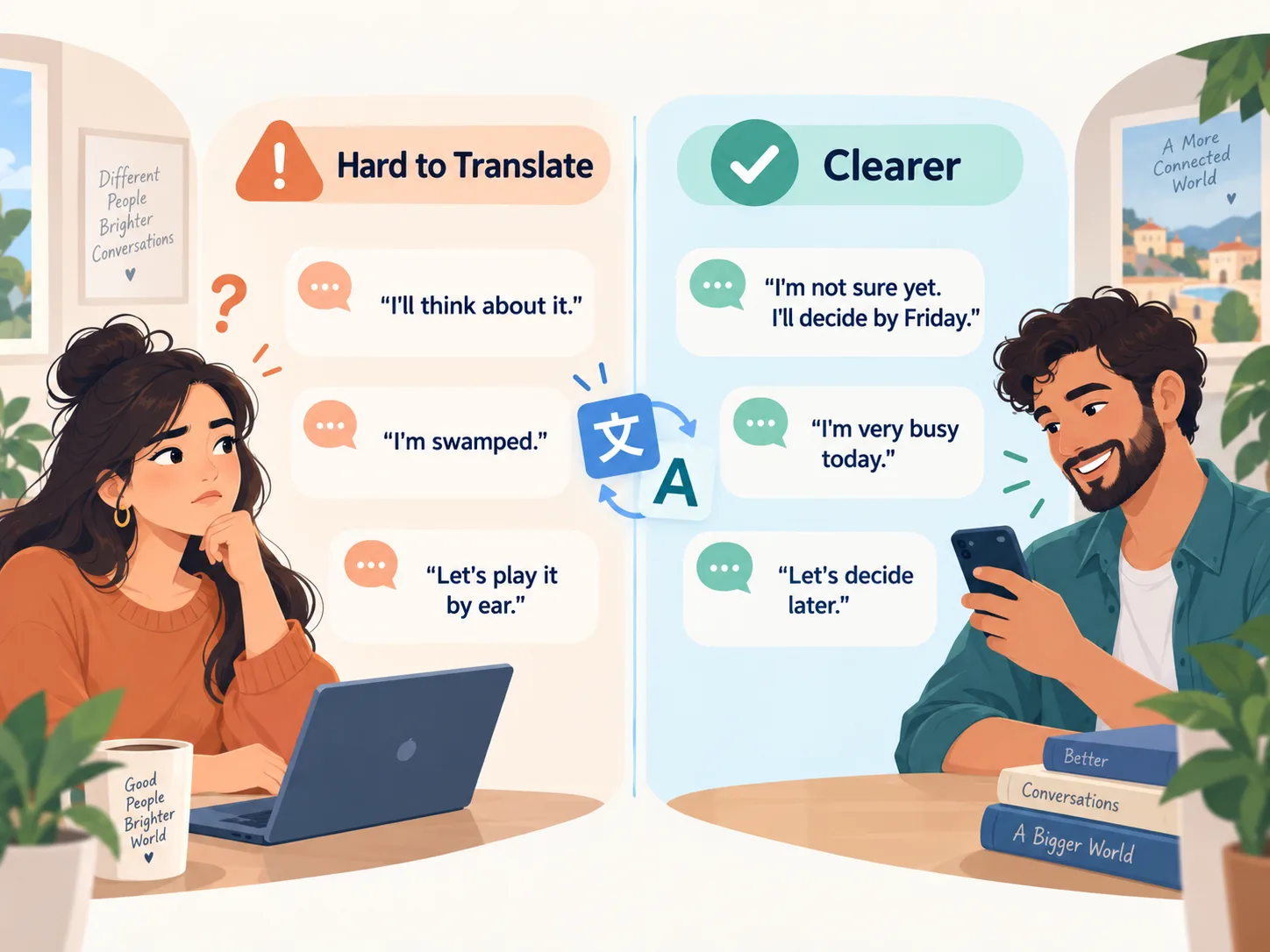
“I’m swamped.”
say:
“I’m very busy today.”
Instead of:
“Let’s play it by ear.”
say:
“Let’s decide later depending on the situation.”
Simple language is not bad language. It is easier to translate accurately.
3. Keep sentences short
Long sentences create more opportunities for a translation to go wrong.
Instead of putting several ideas into one sentence, separate them.
Less clear:
“I talked to John about the meeting yesterday and he said it might be difficult because he has another appointment.”
Clearer:
“I talked to John yesterday. He may not be able to attend the meeting because he has another appointment.”
One idea per sentence is a good rule when accuracy matters.
4. Be specific about people, dates, and plans
Pronouns and vague expressions can easily create confusion.
Instead of:
“He said he’ll send it later.”
say:
“John said he will send the document this afternoon.”
And instead of:
“Let’s meet next Friday evening.”
use an exact date and time when possible.
“Let’s meet on September 18 at 7 PM.”
The more important the message is, the less you should make the other person guess.
5. Be careful with humor, sarcasm, and indirect answers
Sarcasm is difficult even between native speakers.
Consider:
“Great. Just what I needed.”
Depending on the situation, it could mean genuine happiness or complete frustration.
The same problem exists with phrases such as:
“We’ll see.” “I’ll think about it.” “I guess.” “Fine.”
These expressions often carry meaning through tone and culture rather than the words themselves.
If the meaning matters, make it explicit.
Instead of:
“I’ll think about it.”
try:
“I’m not sure yet. I’ll decide by Friday.”

6. Remember that AI still has to guess sometimes
AI translation has improved dramatically.
It will probably become much better at understanding humor, relationships, cultural differences, implied meaning, and subtle changes in tone.
But we’re not completely there yet.
A translation can be grammatically correct while still missing what the speaker actually intended.
For example, in some cultures:
“I’ll think about it.”
may be a polite way of saying no.
In another culture, the listener may understand it literally and expect an answer later.
AI can translate the sentence perfectly and still miss that cultural difference.
This is also why OllaTalk uses the surrounding conversation as context when translating messages. A sentence can be ambiguous on its own, but the messages around it often make the intended meaning much clearer.
More context does not eliminate every misunderstanding, but it gives the translator more information to work with.
So for now, a useful rule is:
Don’t make the translator guess what you mean.
The clearer the original message is, the more reliable the translation will be.
7. Confirm important information
For casual conversation, a small misunderstanding usually doesn’t matter.
For money, travel, work, appointments, or relationships, it might.
When something is important, confirm the meaning once more.
For example:
“Just to confirm: we’ll meet at the hotel lobby at 7 PM on Friday.”
It may feel repetitive, but one extra sentence can prevent a much bigger misunderstanding.
Clear beats clever
You don’t need to write like a textbook just because you’re communicating across languages.
You can still be casual, friendly, funny, and yourself.
But when a message goes through translation, clarity becomes more important than sounding perfectly natural.
Avoid unnecessary ambiguity. Use simple sentences. Say what you actually mean.
AI translation will keep getting better.
Until then, the best approach is simple:
Write for the person on the other side — and for the translator in between.